Monday, May 3, 2021

What Does It Mean to Be Catholic?

 From Return to Order:

Throughout his political career, including the 2020 general election, Mr. Biden has favored the legalization of procured abortion. In more recent years, he embraced same-sex “marriage,” officiating at one while vice president.

Post-inauguration, his administration issued a statement specifying its support for abortion and contraception, not only in America but around the world:

In the past four years, reproductive health, including the right to choose, has been under relentless and extreme attack. … The Biden-Harris Administration is committed to codifying Roe v. Wadeand appointing judges that respect foundational precedents like Roe. We are also committed to ensuring that we work to eliminate maternal and infant health disparities, increase access to contraception, and support families economically so that all parents can raise their families with dignity [sic]. This commitment extends to our critical work on health outcomes around the world.1

Regarding homosexuality and “transgenderism,” the pro-LGBT sentiment of his cabinet and cabinet-level appointments is well-known. Mr. Biden also signed an executive order affirming that his administration’s policy is that “Children should be able to learn without worrying about whether they will be denied access to the restroom, the locker room, or school sports.”2 Likewise, he reinstated “transgenderism” in the Armed Forces,3 and, according to Antony Blinken, his now-confirmed Secretary of State, “he plans to swiftly appoint an LGBTI envoy, [and] allow embassies to fly the pride flag.”4 (Read more.)


Share

North Korea Vows to Respond

 From Resist the Mainstream:

North Korea issued a warning to the U.S. after the Biden administration announced the completion of a months-long review of its approach to Pyongyang going forward. Reuters reported that an unnamed spokesman from the country said it was clear that the U.S. is preparing for an “all-out showdown.”

The statements, carried on state news agency KCNA, come after the White House on Friday said U.S. officials had completed a months-long review of North Korean policy, and underscore the challenges U.S. President Joe Biden faces as he seeks to distance his approach from the failures of his predecessors. read more

In one statement, a Foreign Ministry spokesman accused Washington of insulting the dignity of the country’s supreme leadership by criticizing North Korea’s human rights situation.

The human rights criticism is a provocation that shows the United States is “girding itself up for an all-out showdown” with North Korea, and will be answered accordingly, the unnamed spokesman said.

In a separate statement, Kwon Jong Gun, director general of the Department of U.S. Affairs of the Foreign Ministry, cited Biden’s first policy speech to Congress on Wednesday, where the new president said nuclear programs in North Korea and Iran posed threats that would be addressed through “diplomacy and stern deterrence.”

Kwon said it is illogical and an encroachment upon North Korea’s right to self-defence for the United States to call its defensive deterrence a threat.

“His statement clearly reflects his intent to keep enforcing the hostile policy toward the DPRK as it had been done by the U.S. for over half a century,” he said, using the initials for North Korea’s official name. Kwon said U.S. talk of diplomacy is aimed at covering up its hostile acts, and its deterrence is just a means for posing nuclear threats to North Korea. (Read more.)

Share

Foundings, Roman and American

 From Spencer A. Klavan at the Claremont Review of Books:

Scholars have only recently started reading Virgil as a covert critic of Augustus, much as they have only recently begun insisting that Western culture answer for its sins of prejudice and exclusion. The two impulses likely spring from the same source: a rising discomfort with attitudes expressed in the West’s great masterworks which now seem beyond the pale in erudite circles. Motivated by that discomfort, scholars have gone looking for nuance, admonishments, and even censure of Augustus in the Aeneid. This “pessimistic” reading was, so far as we know, unheard of in antiquity—in the 4th century, Maurus Servius Honoratus wrote in the preface to his monumental commentary, “Virgil’s intention is this: to emulate Homer and praise Augustus via his ancestors.” The first person to contest that assessment in a sustained and influential way was Harvard classicist Robert A. Brooks in his 1953 essay, “Discolor Aura.” Brooks and the others who followed him, such as Yale’s Adam Parry in “The Two Voices of Virgil’s Aeneid” (1963), were serious scholars. They did not scrap the traditional reading entirely so much as suggest that some of the poem’s more subversive tendencies had been overlooked. But it is difficult not to view this shift in emphasis—away from the poem’s obvious triumphalism and toward its subtler undercurrents of self-conscious unease—as a product of postwar anxieties which continue to haunt us. (Read more.)

Share

Sunday, May 2, 2021

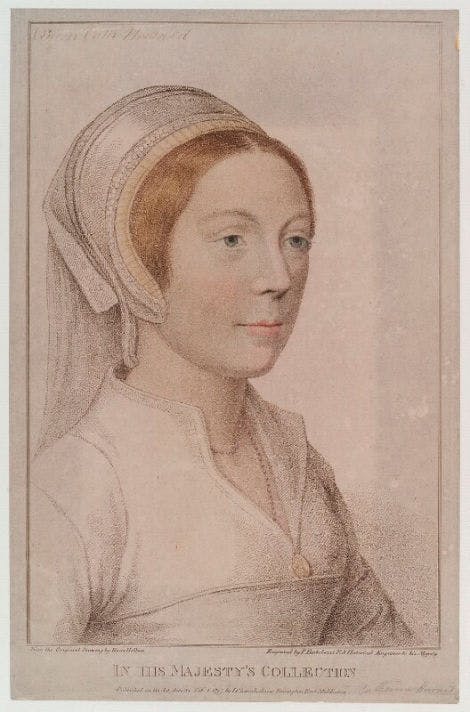
The True Age of Catherine Howard

From Royal History Geeks:

According to historian Gareth Russell, Catherine’s most recent biographer, there is more to this debate than meets the eye.

“The idea that Catherine was born in 1525 is based on a misreading of her grandparents’ wills,” Gareth explains. “It’s an understandable mistake. But it is unambiguously a mistake.”

“The most compelling evidence for Catherine’s year of birth comes from Charles de Marillac, French ambassador to Henry VIII’s court. He knew Catherine well. They went on long hunting trips in the summers of 1540 and 1541. And he was paid to make these kinds of things his business.

“de Marillac reported that Catherine was 18 when she debuted at court at the tail end of 1539. While he may have been basing this on her appearance, four years is too big a mistake to make.

“Some argue that de Marillac had poor form when it came to age guessing. They point out that he estimated 24-year-old Anne of Cleves’s age at 30. But this is a misunderstanding. He doesn’t get Anne’s age wrong. He says that if you saw her, you would guess her age at 30, meaning that she looked older than she was. He’s making an unchivalrous comment, not – at least from a biographical point of view – an inaccurate one.

“There’s also a widely-held view that 14 was deemed an acceptable age to marry in Tudor England. But it’s a bit more nuanced than that. Many believed that a 14-year-old would struggle to bring a child to term. Given the primary role of a Queen was to bear heirs, if Henry had taken a wife as young as that, it would have been more widely remarked upon.

“Given this evidence, a birthdate of circa 1521/22 emerges as the most likely.” (Read more.)


More HERE. 

My review of Gareth Russell's bio of Catherine Howard, HERE.

Share

The Reality of Pandemic

 From Life Site:

In February, people were aching to know the answer to the following. Would this “novel virus” have familiar patterns we associate with the flu, seasonal colds, and other predictable and manageable pathogens? Or would this be something entirely different, unprecedented in our lifetimes, terrifying, and universally deadly?

Crucial in this stage was public-health messaging. In previous pandemics from post-1918 throughout the 20th century, the central messaging was to stay calm, go to the doctor if you feel sick, avoid deliberately infecting others, and otherwise trust the systems in place and keep society functioning. This was long considered responsible public-health messaging, and this was pretty much where we stood throughout most of January and February, when publications regardless of their political outlook maintained sobriety and rationality.

Something dramatically changed this time. They pushed panic, tapping into a primal fear of disease. The reality of pandemic, as it turns out, has been familiar. The severity of its impact has been radically disparate across demographics, hitting mainly the elderly and infirm with 40% of deaths tracing to long-term care facilities with an average age of death nearly equal to the average lifespan. It is regionally migratory. It follows a seasonal pattern from pandemic to its endemic equilibrium. (Read more.)
Share

Ending the New York Slave Trade

 From Smithsonian:

The men of the “Portuguese Company,” about a dozen in total, arrived in 1850s Manhattan ready to bring the illegal slave trade to America’s mega-metropolis. Hailing from Brazil, Portugal and Angola, the group earned their moniker from their common tongue. They were attracted by New York’s large port, with ample ships and sailors, as well as the city’s vast financial services and lax law enforcement. Posing as merchants in legal business, the Company snapped up hundreds of ships to send to Africa for captives and then to the sugar estates of Cuba. The Company would traffic thousands of Africans for their own enrichment, but they also crossed Cuban immigrant Emilio Sanchez, whose spycraft for the British government would prevent thousands more from enduring the Middle Passage aboard American slave ships.

Sanchez’s turn to informant is just one example of how fighting slavery was a collective effort. A wide cast of characters, from the great orators of the abolitionist movement to the conductors of the Underground Railroad to men like Sanchez fought against the institution of slavery and all its components, including the illegal international slave trade. Their work was dangerous, their foes were powerful – even in the “free” North – and the U.S. government was rarely on their side. (Read more.)


Share

Saturday, May 1, 2021

A 19th-Century Paris Loft is Reborn


 From Veranda:

It was this exactitude that attracted the owners of a three-bedroom Parisian apartment between the Place de la Concorde and Élysée Palace. The Geneva-based couple (and parents of three young children) needed to secure the mid-19th-century loft structurally before furnishing it for their family as a pied-à-terre, and “Raphaël and Thomas’ attention to detail is undeniable,” enthused the husband. The flat’s former owner was an aristocrat who had installed wood paneling from a château in several spaces, including the master bedroom and bathroom. But despite the noble embellishments, there was evidence of severe structural problems. “In some rooms, there was a difference of seven inches in the floor level from one side to the other,” recounts Le Berre with incredulity. In addition to correcting this, the designers addressed a slightly idiosyncratic request from the owners. “They didn’t want to hear any noise at all,” declares Vevaud. “We treated the entire space with soundproofing. We joke that it’s like a panic room.” The layout was also significantly revised: The kitchen moved to the heart of the apartment, doorways and passageways were adjusted to create greater symmetry, and a large picture window was installed in the dining room to offer a view of the building’s garden from the entry hall. (Read more.)

Share

Libertinage and Revolution

 From The London Review of Books:

The revolution,’ Baudelaire wrote in his notes on Les Liaisons dangereuses, ‘was made by voluptuaries.’ He was drawing attention to two paradoxes. One was the role that France’s free-thinking, pleasure-loving aristocrats – the real-life versions of Laclos’s characters – played in instigating this upheaval, undermining the system that upheld their privilege. As Louis-Philippe, Comte de Ségur, observed: ‘Without regret for the past, without anxiety for the future, we walked gaily across a carpet of flowers which concealed the abyss beneath.’ After Louis XVI’s execution in January 1793, Robespierre enjoined citizens of the new order to sacrifice their personal interests on the altar of the public good. He was particularly keen that the grandees of the Ancien Régime be punished for indulging their own desires at the expense of the people. He also banned women from politics, on the grounds that royal ‘favourites’ had corrupted the government with their sensual wiles. This is Baudelaire’s second paradox. As Philippe Sollers put it: ‘Are we to understand that [the revolution] was punished ... by puritans? All indications show that it was.’

Laclos was imprisoned for most of 1794 at the Maison Coignard, a former convent in Picpus in eastern Paris, where Donatien-Alphonse-François, ci-devant marquis de Sade, was also being held. Despite their noble backgrounds and royal connections, both men had supported the revolution from the start. They had both served the republic – Sade in the municipal government of his Paris neighbourhood (ominously rebranded the Pikes Section), and Laclos, a career military officer, as a commissar in the Ministry of War. Despite this, they had been jailed during the Terror and condemned to death. They only survived because Robespierre was sent to the guillotine before their sentences could be carried out.

Patrician libertinage co-existed uneasily with revolutionary liberté. A similar tension runs through Benedetta Craveri’s The Last Libertines, a group portrait of seven French aristocrats, contemporaries of Laclos and Sade. Craveri notes in the preface that her title refers to ‘libertinism in its broadest sense’, by which she apparently means the ‘sexual freedom [that] had become customary among the nobility, both male and female’, in the pre-revolutionary period. But the word also means something specific in French literary and philosophical culture, as Craveri’s frequent recourse to it implies. Heirs ‘to a century of libertinism’, her protagonists aren’t merely ‘fashionable libertines’; they are steeped in ‘classical libertinism’ and embrace ‘libertinism as an ideal of life’, performing exploits that recall ‘the best of the libertine novels’. Although she identifies a ‘libertine’ in passing as a ‘systematic seducer, driven by a blind will to dominate’, and mentions ‘a logic of a libertinism that turns desire to entirely foreign ends’, she doesn’t otherwise do much to define her central term.

According to Diderot and d’Alembert’s Encyclopédie, the word ‘libertine’ originally designated a 16th-century Dutch sect who maintained that ‘there is no such thing as sin...that heaven is an illusion and hell a phantom invented by theologians; that political leaders created religion to enforce obedience to their laws’. In the 17th century, Cyrano de Bergerac described similar precepts in a pair of satirical novels set in outer space. Their defiance of Church doctrine qualified these books as products of a ‘libertine’ imagination, and marked the emergence of a new genre. Over the course of the 18th century, libertinism retained its anticlerical spirit while becoming more closely linked with the pleasures of the flesh. Towards the middle of the century – when Laclos, Sade and most of Craveri’s subjects were born – the ascendance of the philosophes brought bracing Enlightenment challenges to established mores and institutions. In certain worldly circles, the restrictions that Church doctrine and social custom imposed on sexuality drew especially vigorous criticism. Self-proclaimed libertines rejected constraints on premarital virginity and conjugal fidelity, heterosexuality and monogamy, chastity in women and chivalry in men. Evolving from the mid-century contributions of Diderot and Crébillon fils, libertine fiction reached its artistic highpoint in Laclos’s first and only novel, published seven years before the fall of the Bastille, and its philosophical endpoint in Sade’s prolific writings, produced between 1782 and 1801. (Read more.)
Share

The Last Byzantine Emperor

 From The Greek Reporter:

Constantine XI Palaiologos was born on February 8, 1405, the eighth of ten children of Emperor Manuel II Palaiologos and his wife Elena Dragases, daughter of the Serbian ruler Konstantin Dejanovic. Little is known about Constantine’s life before his rise to the throne of Byzantium. He was a skilled general and he and his brothers commanded the Despotate of Mystras, in Moreas, today’s Peloponnese. In 1427–1428, Constantine and his brother Ioannis fended off an attack on the Moreas by Carlo II Tocco, the ruler of Epirus, and in 1428 Constantine was proclaimed as Despot of the Moreas, to rule the province together with his older brother Theodore and his younger brother Thomas. Together, the Palaiologos brothers extended Byzantine rule to cover almost the entire Peloponnesian peninsula for the first time since the Fourth Crusade, more than two hundred years prior.

They rebuilt the ancient Hexamilion wall, which defended the peninsula from outside attacks, and in 1444-1446, Constantine personally led a campaign into Central Greece and Thessaly in an effort to extend Byzantine rule further into Greece. The Byzantine Empire was in decline when Constantine was proclaimed emperor on  January 6, 1449, after the death of his brother Ioannis. It was a time when the Ottomans were on the rise, taking over land that had been under Byzantine rule.

Constantine made an effort to unite the Orthodox Church with the Catholic Church in the hope that the Catholics would provide military aid to stop the advance of the Ottomans. But this stratagem was sadly to no avail. Four years after assuming power in Byzantium, Constantine Palaiologos was called upon to counter the third siege of Constantinople by the Ottomans — a siege that began on April 15, 1453 and ended in the Fall of the city on May 29 of the same year. (Read more.)

Share