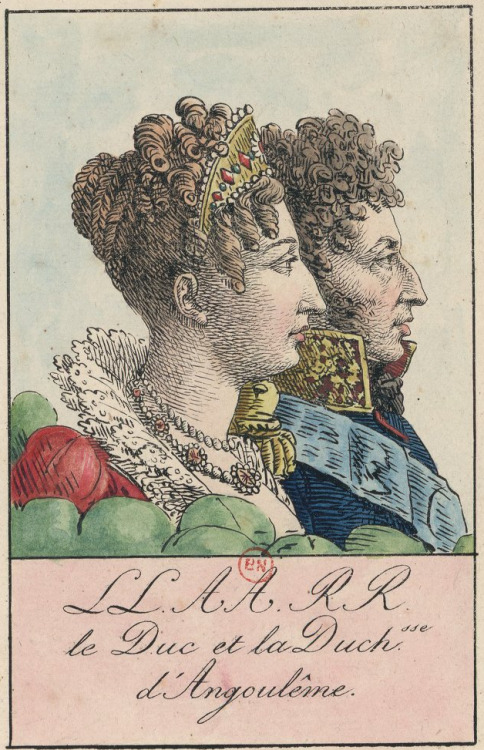
In 1813, during her exile in England, Marie-Thérèse-Charlotte, the duchesse d’Angoulême, experienced a pregnancy and a miscarriage. It is called a "miscarriage" although it sounds as if she might have been far enough along for it to be a a still-birth. The baby was the grandchild of Louis XVI and Marie-Antoinette. Susan Nagel's biography of the princess is the only one I have read to describe the sad event. To quote (Via
Tiny-Librarian):
As she turned thirty-four, on December 19th,
1812, Marie Therese seemed overflowing with happiness. On January 27th,
1813, Princess Charlotte gave a ball and noticed that d’Angouleme too
was in high spirits. In a letter dated February 7 to her friend, Miss
Mercer Elphinstone, the English Princess made a special note that at her
grand fete, d’Angouleme proved to be a wonderful dance partner. Marie
Therese’s doctor, Monsieur Lefebvre, knew the reason for the couple’s
ebullience, as he would explain to Hue that January: “At this moment, I
am tending to a woman who lives above me and is pregnant for the first
time after more than thirteen years of marriage.”
On January 30, Hue wrote to his wife that Dr Lefebvre had given
him the miraculous news that the Duc D’Angouleme would be a father in
June. The doctor confirmed this in his own handwriting on the same
letter. Madame Hue received the note and added a formal sentence on the
paper: ‘Monsieur Hue and Monsieur Lefebvre designate Madame the Duchesse
D’Angouleme, announcing her pregnancy’. On February 15, 1813, Louise de
Conde wrote to her father that she was stunned to hear of the pregnancy
as she had heard for years that, while Marie-Therese had been in the
Temple Prison, The Jacobian guards had bragged about destroying her
fertility with a combination of drugs. Marie-Therese’s joy was to be
short lived. Quite a few months into the pregnancy, she suffered a
miscarriage and that summer left for Bath to recuperate.
Marie Therese, Child of Terror: The Fate of Marie Antoinette’s Daughter - Susan Nagel
In her early forties, Marie-Thérèse again experienced the symptoms of pregnancy but it turned out to be a false call, much to her great disappointment.
How sad. It is touching to think that there was a grandchild of Louis and Antoinette.
ReplyDeleteFor a woman who had suffered so much tragedy, having the joy of giving birth taken from her was, to say the least, devastating I am sure.
ReplyDeleteAgain, I've learned something new on your blog. Thank you.
ReplyDelete